

Palau Güell
The Building is an early work of the architect Gaudí
The Palau Güell is Antoni Gaudí's first major work in Barcelona for his patron Eusebi Güell. He created one of the most magnificent buildings of modernisme.
Content of this page
The Palau Güell is located in the Raval district, a few meters from the Rambla.
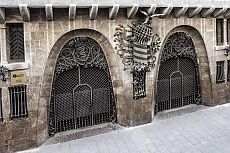
Parts of the building's façade are reminiscent of a Venetian palace. The two large oval gates at the front are particularly striking: through these, carriages could drive directly into the horse stables. Guests then went up stairs to the upper floors.
Tickets and guided tours
- Visit a unique Gaudí masterpiece near Las Ramblas
- Get tickets to the Palau Güell and visit the first important commission Antoni Gaudí received early in his career
- Skip-the-line entry to Palau Guell
- Access to all visitable areas of the building, including the roof terrace
- Downloadable audio guide in 13 languages (options: general, express and children)
- Ticket also on the smartphone
- Immediate ticket delivery
- Guided tour in Palau Güell
- Get tickets to the Palau Güell and visit the first important contract Antoni Gaudí received early in his career
- Access to all visitable areas of the building, including the roof terrace
- Live guide: English, Spanish or Catalan
- Ticket also on the smartphone
- Immediate ticket delivery
The history of the Palau Guell
The Palau Güell is one of the early works of Antoni Gaudí in Barcelona and one of the most magnificent buildings of modernisme. It is located in the Raval district, a few meters from the Rambla. Parts of the Palau Güell's façade are reminiscent of a Venetian palace, with the two large oval gates at the front being striking. Through these you could drive carriages directly into the horse stables. Guests then went up stairs to the upper floors.
The Palau Güell has been on the UNESCO World Heritage List since 1984. The building reopened in 2011 after 7 years of renovation.
Palau Güell (Video in Catalan)
In 1885 Gaudí was commissioned by his patron, the industrialist Eusebi Güell i Bacigalupi, to design a city palace. Construction began in October 1886. The palace was opened for the 1888 World Exhibition, although the work continued beyond that.
The architect Antoni Gaudí
Palau Güell is an early work of Gaudí. It has been on the UNESCO World Heritage List since 1994.

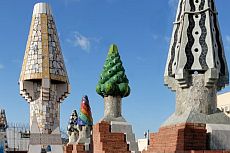
The distinctive chimneys so typical of Gaudí were installed on the roof in 1895. There are a total of 20 chimneys on the roof, which also serve to ventilate the house.
The Palau Guell building
The Palau Güell was to be a multi-purpose building. With apartments, event and exhibition rooms. There was just 18x22 meters of floor space available to build a palace that was as magnificent as it was functional. The task was brilliantly solved by Gaudí, he created one of the most magnificent buildings of modernisme.
However, Gaudí not only built houses, he was also a designer and decorated the house with impressive ironwork, woodwork, ceramics, stained glass and stone work.
Basement Palau Guell
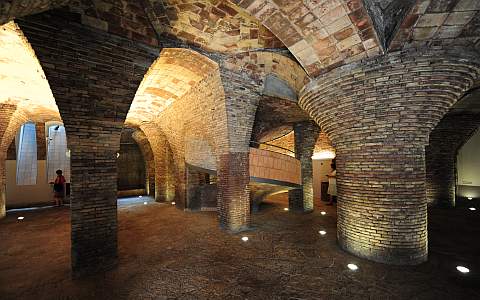
In the basement were the stables for horses and sleeping quarters for the servants. The basement was reached via two spiral ramps.Two large, oval entrances made it easy to get into the house in a horse-drawn carriage. The ramp for the horses led from the carriage hall at the back into the basement.
The ground floor
The workrooms and a library of the landlord Eusebi Güell and other administrative rooms were on a mezzanine floor. The magnificent entrance hall is also on this floor, from which an equally magnificent staircase leads to the Beletage, the floor of the master's family. The main level of the house also includes a grandstand on the north side that covers the entrances to the house.
The piano nobile
The center of the piano nobile is a 17 meter high salon decorated with murals. The roof of the salon forms a parabolic dome. The salon was used for social occasions and religious services were also held here. The northern rooms of the bel étage were dedicated to social occasions, the southern part was used for family purposes, such as the dining room or the billiard room.
Private rooms on the 2nd floor
The family's private quarters were on the second floor, facing the window gallery facing the large drawing room.
The attic for the employees
The attic housed the rooms for the domestic staff and supply rooms such as the kitchen, pantry and washrooms.
Roof terrace
On the terrace there is a long spire covering the dome of the great salon and 20 fireplaces decorated with ceramics.
The industrialist Eusebi Güell
Eusebi Güell i Bacigalupi had a very special relationship with Antoni Gaudí: Güell was his main patron. Without this patronage, Gaudí would certainly not have achieved such outstanding importance. Güell became aware of the young architect's talent at the 1878 World Exhibition in Paris. Gaudí designed a display case for a glove shop. Güell noticed the harmony with the materials iron, wood and glass.
Many of Gaudí's works bear Güell's name: Palau Güell, Colonia Güell - Krypt Gaudí, Park Güell, Pavillon Güell and Celler Güell.
The two maintained a deep and fruitful friendship until Güell's death in 1918.
Why visit the Palau Güell
The Palau Güell is an early work by Antoni Gaudí. Some elements typical of Gaudí can also be found in later buildings, such as the ironwork at the entrance and on the back of the building or the chimneys or ventilation openings on the roof. In contrast to the light-flooded later buildings, the Palau Güell seems almost gloomy. You will also find exciting architectural details inside, which also reflect the zeitgeist of the time. The stables in the basement with the sleeping quarters for the grooms, the sumptuous quarters of the master of the house and the quarters of the staff on the top floor are perfect examples of this.
The Palau Güell is a fine example of the development of the brilliant architect Gaudí. It is rightfully on the UNESCO World Heritage list and is one of Barcelona's top attractions.
Book tickets for Palau Güell here
(Click on the product images to view prices and availability)
Important information

Surroundings
Find Hotels nearby
Address
Nou de la Rambla, 3-5
www.palauguell.cat
Arrival
Metro: Liceu (L3)
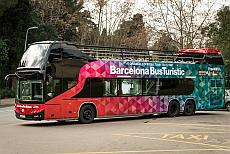
Bus Turístic: Colom - Museu Marítim
Parking nearby
Opening times
April-Oct.: 10.00 - 20.00
Nov-Mar: 10.00 - 17.30
Last admission one hour before closing.
Closed on Mondays (except public holidays)
Closed: 01 and 06 January, 25 and 26 December, last week of January for maintenance
Admission
Regular: €12.00 (audio guide included)
Reduced: €9.00
11-17 years: €5.00
Up to 10 years: free admission
With the Barcelona Card you get a 25% discount on admission.
Tips for the visit of the Palau Güell
Schedule about 1.5 hours for the visit. Only a limited number of people have access to the Palau Güell. It's not as crowded then, but the waiting times are longer. We therefore recommend booking in advance.


Book your accommodation in Barcelona here! All categories.
1-5*-hotel rooms, apartments, hostels.