

The opera house Gran Teatre del Liceu
Discover one of the largest opera houses worldwide - with fascinatingly beautiful architecture
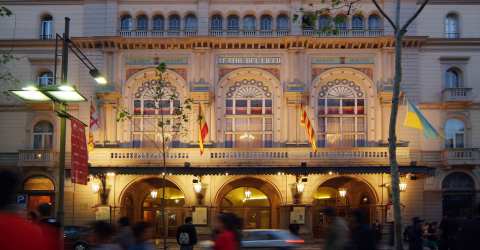
The Gran Teatre del Liceu is one of the most important opera houses in Europe. The largest Wagner Festival after the Bayreuth Festival takes place here regularly.
The most important works of classical music have been performed by the greatest singers of the past two decades. Stars like Domingo, Pavarotti, Caballé, Callas and Tebaldi were here and will always have a special place in the heart of the audience.
History of the Gran Teatre del Liceu
The beginnings of the opera in Barcelona go back to the Sociedad Dramática de Aficionados in 1837. This union of liberal, armed citizen militia founded a musical conservatory. Under the direction of Queen Isabel II in 1838 it became the "Liceo Filármonico Dramático Barcelonés".
The success of the building "Liceu Filármonico Dramátic" brought a group of leading citizens to plan a new opera house. They wanted to build a more splendid opera house than would have been possible under royal management. To finance this, they founded a company that accumulated profits from stock trading. The members of the "Societat de Propietaris", the owners' company, reserved most of the lodges.
On April 4, 1847, the Gran Teatre del Liceu was opened. It was built according to plans by architect Miquel Garriga i Roca. With 4,000 seats, it was the largest opera in Europe. From 1855 the Societat de Propietaris was solely responsible for the operation of the opera, since it had separated from the conservatory. In 1861, the Liceu was hit by a fire for the first time. The auditorium and the stage were completely destroyed. But only a year later, the opera house was reopened.
The Reconstruction of Liceu after the Fire in 1994
Since 1986, there have been plans to expand and modernize the building. Based on these plans, made by Solà Ignasi de Morales, the Liceu was rebuilt. The original was almost completely preserved, since as many undamaged parts as possible were reused.
Gran Teatre del Liceu
Thus, the magnificent foyer and the equally splendid hall of mirrors were reconstructed according to the original rooms. Below the concert hall, an auditorium with a restaurant was built as a break room for the guests, and the stage was equipped with state-of-the-art technology. The curtain has been modernized and was designed by Antoni Miró. The upper floor seats got TV technology installed, since not all seats have a view on the stage. The geometry of the otherwise faithfully recreated concert hall has been slightly adapted to modern acoustics.
The Gran Teatre del Liceu reopened in 1999 and now has nearly 2,300 seats on 6 levels. The Liceu is an integral part of Barcelona's culture of today.
The financing of opera operations in the Liceu
From the very beginning, since the opening in 1847, theater and opera productions have been awarded to investors, who also received the proceeds from ticket sales. Excluded from this were the seats reserved for the Societat.
However, from around 1975 it became apparent that this type of financing was no longer profitable. A sponsorship from the city of Barcelona, ââthe Catalan regional government and the Societat del Gran Teatre del Liceu, the official name of the "Societat de Propietaris", took over the management of the house. The purely private form of sponsorship financing was converted to public financing in 1980 to save one of the internationally most famous operas.
The fire on January 31, 1994 almost completely destroyed the Liceu. This had an extraordinary social impact on Catalan society. There was debate as to whether the house should be rebuilt at all. A new legal basis was created for the reconstruction of this symbolic building. The assets and all rights were transferred to a foundation, the Fundació del Gran Teatre del Liceu. From now on, the house was completely in public ownership.
Useful for your Barcelona stay
(Click on the product images to display prices and availability)
- Barcelona Card: Many free and reduced admission to sights
- Explore the city with the hop-on hop-off buses
- Guided tour of the Gothic quarter
Important information

Surroundings
Find Hotels nearby
Address
La Rambla, 51-59
www.liceubarcelona.cat/en/
Arrival
Metro: Liceu (L3)
Bus Turístic: Colom - Museu Marítim
Parking nearby
Notes on visiting
The Gran Teatre del Liceu is currently not open to the public. Opera and theater performances can be attended.


Book your accommodation in Barcelona here! All categories.
1-5*-hotel rooms, apartments, hostels.